Programmable savings vaults, trust fund infrastructure and family inheritance on-chain. Built for banks, wealth platforms and family offices. Every child deserves a head start you can see.
A production vault, audited and live from EUR 45,000 Fixed scope · 6 to 10 weeks · EUR 0 funds lost since the first vault shipped in 2006
On this page
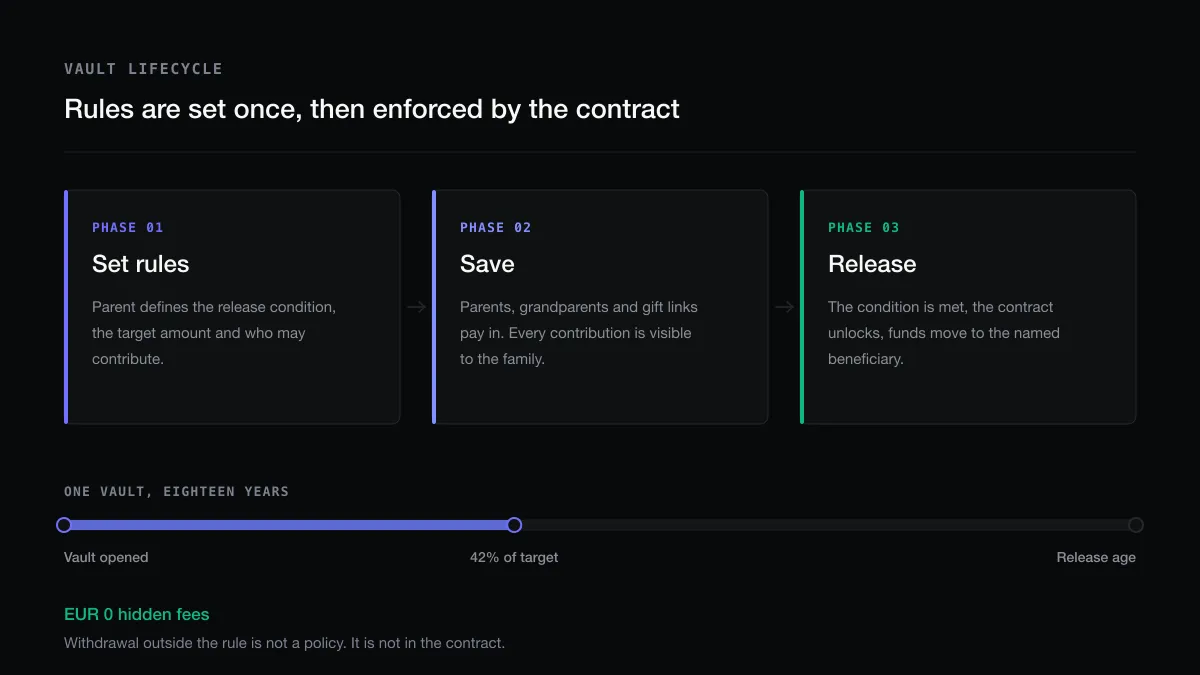
A Blockchain Baby savings vault moves through three phases. A parent sets the release condition and the target once, contributors pay in over the years that follow, and the contract releases the funds when the condition it carries is satisfied. Nobody at the institution can move that condition afterwards.
A parent, guardian or family office configures the vault: beneficiary, release condition (age, education gate or milestone) and a vesting schedule. Rules are encoded on-chain and cannot be quietly changed after deployment.
Regular deposits from the parent and one-click gifts from grandparents or relatives all flow into the same vault under the same rules. Every deposit is visible on-chain with no hidden fees eroding the balance.
When the beneficiary satisfies the release condition the smart contract verifies it on-chain and transfers funds directly. No intermediary approval required and no delay. The head start arrives exactly as planned.
Blockchain Baby builds the full savings, trust and inheritance stack: programmable vaults, on-chain trust and succession contracts, beneficiary registries, white-label consumer apps, tokenized savings positions and the sustain retainer that keeps them running. Six services, each quoted as a fixed scope, each deployable on any of seven production chains.
Production-grade smart contracts that hold funds under parent-set conditions with transparent fee structures, automated releases and on-chain audit trails. Every vault is audit ready from day one.
from EUR 45,000 fixed scope, one chain
Scope a vault build →On-chain trust structures with beneficiary designation, successor logic and multi-heir inheritance routing. Replaces manual probate steps.
from EUR 68,000 fixed scope, multi-heir
Scope a trust suite →Role-based smart contracts govern the registry of vault-to-beneficiary relationships with co-depositor access, guardian overrides and full audit trails for regulators. Permission design is explicit and on-chain, not configurable via a back-office tool.
from EUR 52,000 fixed scope, registry and roles
Scope a beneficiary registry →Complete consumer-facing apps for banks and FinTechs: vault creation, gifting flows, beneficiary dashboards and vesting visualisations. The full blockchain backend development and dApp frontend are included in a single engagement.
from EUR 320,000 app, backend and first year of sustain
Scope a white-label app →Asset tokenization for savings: vault positions represented as standardised on-chain tokens for institutional co-investment structures and regulatory reporting. Includes token vesting contracts with configurable tranche schedules.
from EUR 88,000 fixed scope, standards and vesting
Scope a tokenization build →Ongoing contract monitoring, upgradeability planning, on-call incident response and regulatory compliance maintenance for live savings platforms. Blockchain DevOps and smart contract CI/CD are included in platform-tier engagements.
from EUR 12,000 per month, SLA-backed on-call
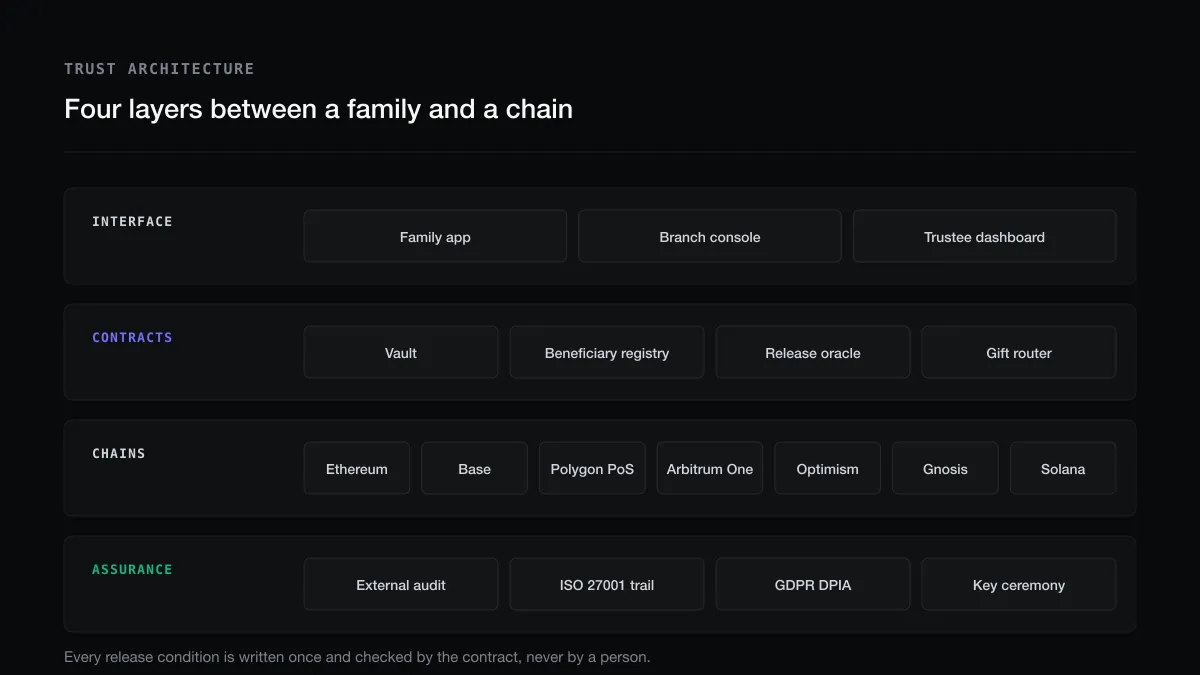
Scope a sustain retainer →Every savings vault and trust contract runs on the same audited stack: Solidity and Rust, Hardhat and Foundry, ERC-20 and ERC-4626 style standards, Chainlink oracles for gated release conditions, The Graph for vault history and Safe for multi-signature custody, across seven production chains rather than one favourite.
Twenty years of savings technology, written as contracts a family can read. Six differentiators carry the argument: release rules a parent sets and an institution cannot quietly change, a published fee schedule, contributions open to relatives, regulatory readiness by design and deployment across seven chains rather than one.
Release conditions, fee structures and vesting schedules are encoded in the contract and visible on-chain. Parents see exactly what will happen with savings and children receive exactly what was promised, with no hidden adjustments.
Rules are configured at vault creation and enforced automatically. No bank branch visit, no discretionary decision by a manager. If the condition is met, the release happens. If not, the funds stay locked. Transaction safety is built into the smart contract, not bolted on after the fact.
Traditional child savings accounts carry opaque management fees that compound over 18 years. Our research found 68 percent of long-term savings were eroded by fees and inflexibility. Our vaults charge published, fixed fees that cannot be quietly changed after deployment.
Grandparents, relatives and family friends can gift directly into any vault in under 60 seconds. Gifts enter under the same release conditions set by the parent and are visible to all authorised parties.
Built CSSF-aligned from Luxembourg, with ISO 27001, SOC 2 Type II, PCI DSS and GDPR DPIA completed. Security-first blockchain development is our baseline, not an optional add-on. Every contract is externally audited before mainnet deployment. 74 production contracts shipped, zero critical findings, EUR 0 funds lost.
Savings vaults deploy on Ethereum, Base, Polygon PoS, Arbitrum One, Optimism, Gnosis Chain and Solana. Multi-chain development is handled within a single engineering team so the smart contract architecture stays consistent across every chain your clients need.
Ten figures describing what Blockchain Baby has shipped rather than what it intends to ship. EUR 1.2 billion is held in programmable vaults across 310,000 families, 74 production contracts have gone to mainnet, every external audit has returned zero critical findings and the record still reads EUR 0 funds lost.
Vault metrics as of Q2 2026. Contract audit records available on request. Uptime measured across all production deployments since 2020.
Market context: the global blockchain technology market is projected to reach USD 94 billion by 2027, with financial services and wealth management among the fastest-growing verticals, per Fortune Business Insights. Family wealth and inheritance on-chain are identified as high-growth segments in the 2025 annual report by the World Economic Forum.
Blockchain Baby builds for four kinds of institution: savings banks and retail banks, wealth platforms and robo-advisors, multi-family offices, plus FinTech platforms and neobanks. What they share is a customer who already holds an account and now needs a long-horizon one that keeps its own rule for eighteen years.
Programmatic child savings accounts, education funds and ISA-equivalent vaults with transparent fee disclosure and regulator-ready audit trails. Our enterprise blockchain development integrates cleanly with existing core banking APIs and custodian infrastructure.
White-label savings and trust modules that plug into existing investment platforms, adding on-chain vaults alongside conventional portfolios with a unified beneficiary dashboard.
Bespoke trust and inheritance contracts for high-net-worth families: multi-heir structures, successor logic, periodic distributions and on-chain estate planning with full auditability.
Blockchain development for FinTech teams that want consumer-facing family savings apps with gifting from grandparents, gamified vault milestones and programmable release conditions, all built on our audited smart contract infrastructure. Web3 development for FinTech is one of our most requested engagement types.
40% of adults in developing economies saved in a financial account in 2024
Formal saving is growing fastest where the account is the new part. Our clients sit at the other end of the same curve: their customers already have accounts, and what they lack is a way to make a long-horizon one hold its rule.
For a regulated bank or a family office, security is the foundation rather than a project phase. Every contract goes through an external audit before mainnet, under ISO/IEC 27001:2022 and SOC 2 Type II, CSSF-aligned in Luxembourg, PCI DSS compliant and covered by a completed GDPR impact assessment.
Furthermore, every execution of a smart contract happens in public and, in addition to that, the source code is often available.
This is the property a family savings vault is built on rather than around. A parent can read the release rule their own vault runs, and so can the auditor, the regulator and the child, eighteen years later.
Six questions separate a supplier who has built savings infrastructure from one who has only read about it: direct vault and custody experience, independent audits, a committed regulated timeline, relevant financial certifications, regulatory coverage spanning MiCA and AML and KYC and FATF, plus who owns the code at the end.
Blockchain Baby has shipped 74 production vault and trust contracts with EUR 1.2 billion currently held in its vault infrastructure.
Every contract is audited by an independent firm before mainnet and Blockchain Baby has shipped 74 contracts with zero critical findings to date.
Our scoped vault builds run 6 to 10 weeks and platform engagements 14 to 22 weeks. All timelines are agreed in writing in the scoping workshop.
We hold ISO/IEC 27001:2022, SOC 2 Type II and PCI DSS. We operate CSSF-aligned in Luxembourg.
Regulatory compliance design is included in every engagement architecture. We have delivered CSSF-aligned and GDPR DPIA-compliant platforms.
The client owns all smart contract source code, deployment keys and documentation from day one of mainnet deployment.
Chain selection is one of the first architecture decisions in a vault build and among the hardest to reverse once contracts hold real money. The table below maps each of the seven production chains against the savings and trust use cases where it performs best, on finality, fee load and compliance fit.
| Chain | Best for | Transaction finality | Regulatory fit | Typical gas cost (EUR) |
|---|---|---|---|---|
| Ethereum | Institutional custody, high-value trust contracts, regulatory-grade audit trails | ~12 seconds (PoS) | Highest: most compliant tooling | EUR 2-15 per tx |
| Base | High-volume consumer vault apps, gifting flows | ~2 seconds | Ethereum-security inherited, lower cost | EUR 0.01-0.05 per tx |
| Polygon PoS | Mid-market savings platforms, cost-sensitive deployments | ~2 seconds | MATIC bridge to Ethereum | EUR 0.001-0.01 per tx |
| Arbitrum One | Complex logic vaults, beneficiary management, DeFi integrations | ~1 second | Ethereum L2 fraud proofs | EUR 0.01-0.10 per tx |
| Optimism | OP stack platforms, government-linked savings pilots | ~2 seconds | OP stack governance | EUR 0.01-0.05 per tx |
| Gnosis Chain | Euro-denominated savings (xDAI), cooperative banks, EU-first deployments | ~5 seconds | EU-friendly, DAI-native | EUR 0.001-0.005 per tx |
| Solana | Ultra-high-frequency gifting, consumer micro-savings | ~400ms | Separate regulatory path | EUR 0.0001-0.001 per tx |
Three fixed engagement models and a time-and-materials option, all priced in EUR with nothing hidden. Every tier covers full-cycle blockchain development from the scoping workshop to mainnet handover, and the benchmark table below sets each fixed price against a published market range wherever a verifiable one exists.
A single production-grade savings vault contract with parent-set release rules, gifting support and an external security audit. Deployed to one chain of your choice.
Complete platform: vault contracts, beneficiary management, gifting, vesting schedules, external audit and a white-label admin dashboard. Multi-chain deployment available.
Full consumer app with vault creation, gifting flows, beneficiary dashboards, vesting visualisations and ongoing sustain with SLA-backed on-call coverage.
| Deliverable | Our fixed price (EUR) | Typical market range (USD) | Market source |
|---|---|---|---|
| Scoping workshop and architecture brief | Included, EUR 0 | $5,000 to $20,000 | Reown, discovery engagement |
| Programmable savings vault build, one chain | from EUR 45,000 | $40,000 to $100,000 | Alchemy, simple protocol build |
| Trust and inheritance contract suite | from EUR 68,000 | No published range found | Nobody prices on-chain succession as its own line |
| Beneficiary and successor registry | from EUR 52,000 | No published range found | Registry contracts are quoted inside larger builds |
| Tokenized savings positions, standards and vesting | from EUR 88,000 | $20,000 to $80,000 | Reown, token issuance and standards |
| Multi-chain vault deployment | from EUR 64,000 | $30,000 to $120,000 | Reown, cross-chain integration |
| External security audit, single contract | At cost, quoted separately | $5,000 to $250,000 | Sherlock, audit pricing reference |
| Node, indexer and oracle setup | from EUR 14,000 | $2,000 to $5,000+ on a public chain | Cleveroad, infrastructure setup |
| Full savings, trust and beneficiary platform | EUR 95,000 to EUR 280,000 | $200,000 to $500,000+ | Alchemy, complex protocol build |
| Sustain and on-call, monthly | from EUR 12,000 per month | $5,000 to $15,000 per month | Alchemy, maintenance retainer |
Market ranges are quoted from the source named in each row, read at that source's own published pricing page. Two rows carry none because no vendor, consultancy or registry we opened publishes a price for that deliverable on its own; a guess in those cells would read exactly like the eight that are real, which is the reason they stay empty in words rather than in numbers.
All engagements include a scoping workshop, architecture review and mandatory external security audit before mainnet deployment. External audit fees are included in platform and white-label tiers; quoted separately for vault builds.
Six factors decide what a savings vault or trust platform engagement costs: contract scope and complexity, the number of chains, audit depth and auditor tier, regulatory integrations, oracle integrations and timeline compression. Understanding them before the first call is what lets a scoping workshop produce an accurate number.
A single vault with one release condition takes fewer cycles than a multi-heir trust with oracle-gated conditions and a tokenised position. Complexity is the primary cost driver.
Each additional chain requires a separate deployment, chain-specific testing and its own audit scope. Seven-chain deployments cost more than single-chain.
A standard external audit is included in platform and app tiers. A top-tier auditor for an institutional custody vault increases the audit line item.
CSSF-aligned reporting modules, GDPR DPIA documentation and AML/KYC hooks are separately scoped and add to the base contract cost.
Education-gate conditions, real-world age verification or custom data feeds require oracle design, testing and ongoing fee budgeting.
Accelerated delivery (under 6 weeks for a vault build) requires a larger parallel team and is priced on a time-and-materials basis at EUR 1,400 per engineer day.
| Sourcing model | Cost profile | Time to first line of code | External audit access | Bus factor | Retention risk |
|---|---|---|---|---|---|
| In-house team | Highest fixed cost. Salaries continue between projects and a Solidity hire in Western Europe is a competitive one. | 3 to 9 months. Hiring, onboarding and a first vault written by people learning the domain on your money. | You commission and pay for it yourself, and you negotiate the queue with the audit firm alone. | Low at first, then concentrated. The one engineer who wrote the release logic becomes the only person who understands it. | Highest. A departure takes the contract knowledge with it and the code stays deployed either way. |
| Specialist agency | Fixed price against a defined scope. From EUR 45,000 for a vault build here, with the audit quoted separately. | 2 to 3 days. The scoping workshop is the first phase and code starts in week two of the delivery path. | Included in the engagement and booked as part of the plan. Every contract is audited before mainnet. | Shared across a team that has shipped the pattern before. 74 production contracts stand behind the same code paths. | Lowest for the client. Turnover happens inside the supplier and the handover obligation does not move. |
| Freelance contractors | Lowest headline rate, least predictable total. Scope changes and re-audits are billed as they arrive. | Days to weeks, depending entirely on who is free. Fastest start, least certain finish. | Your responsibility to arrange, and the auditor has no prior relationship with whoever wrote the code. | Lowest. Usually one person, often on one machine, sometimes with the deployment key. | High. The engagement ends when the contract ends and there is no organisation left to call. |
We are the middle row and we will say when the other two are the better answer. A team that ships savings products continuously belongs in-house, and a one-off proof of concept with no audit requirement rarely justifies a fixed-scope engagement.
Three ways to work with Blockchain Baby, set side by side. Every tier delivers production-grade audited contracts. What differs is scope, chain count, support depth and whether the mandatory external audit is included in the price or quoted separately against the specific deliverable it covers.
| Tier | Scope | Timeline | External audit | Multi-chain | Price |
|---|---|---|---|---|---|
| Vault build (Fixed scope) | Single production vault contract with release rules, gifting, audit | 6-10 weeks | Included (quoted separately) | 1 chain | from EUR 45,000 |
| Full platform (Dedicated team) | Vault suite, beneficiary management, vesting, white-label admin dashboard | 14-22 weeks | Included | Up to 7 chains | EUR 95,000-280,000 |
| White-label app (White-label + sustain) | Consumer app, gifting UX, dApp, sustain retainer, SLA | 20-30 weeks | Included | Up to 7 chains | from EUR 320,000 |
| Time-and-materials | Scoped modules, integrations, consulting | Variable | Quoted per module | Variable | EUR 1,400/day |
| Sustain retainer | Contract monitoring, upgrades, on-call coverage | Ongoing | N/A | All deployed chains | from EUR 12,000/month |
On-chain savings infrastructure changes what a family can verify and what an institution has to administer by hand. The comparison below sets a programmable vault against a traditional savings account on fee visibility, release control, contributor access, audit trail and the operational risk each model leaves behind.
| Feature | Blockchain Baby vault | Traditional savings account |
|---|---|---|
| Parent-set release conditions | ✓ Encoded on-chain, immutable after deployment | ✗ Internal bank policy, can change without notice |
| Fee transparency | ✓ Published, fixed fees visible on-chain | ✗ Variable management fees often buried in T&Cs |
| Third-party gifting | ✓ Any wallet contributes in under 60 seconds | ✗ Requires a branch visit or slow bank transfer |
| Vault setup time | ✓ Average 4 minutes | ✗ 2 to 5 business days including ID checks |
| Audit trail | ✓ Full on-chain history, publicly verifiable | ✗ Internal records, accessible only on request |
| Vesting schedule | ✓ Granular tranche schedule, set at creation | ✗ Lump sum only, date set by bank |
| Inheritance routing | ✓ Multi-heir contracts with successor logic | ✗ Probate process, weeks to months of delay |
| Multi-chain availability | ✓ 7 chains: Ethereum, Base, Polygon PoS and more | ✗ Single institution, single jurisdiction |
| Regulatory compliance | ✓ ISO 27001, SOC 2 Type II, CSSF-aligned, GDPR | ✗ Varies by bank; often only local regulation |
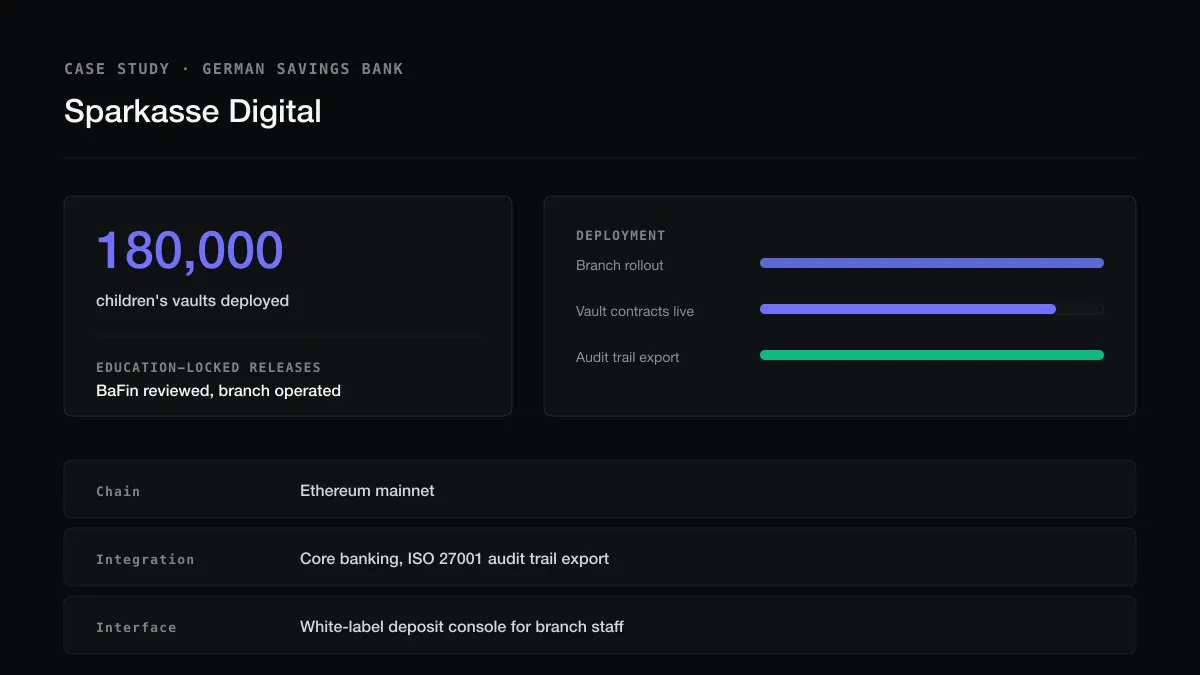
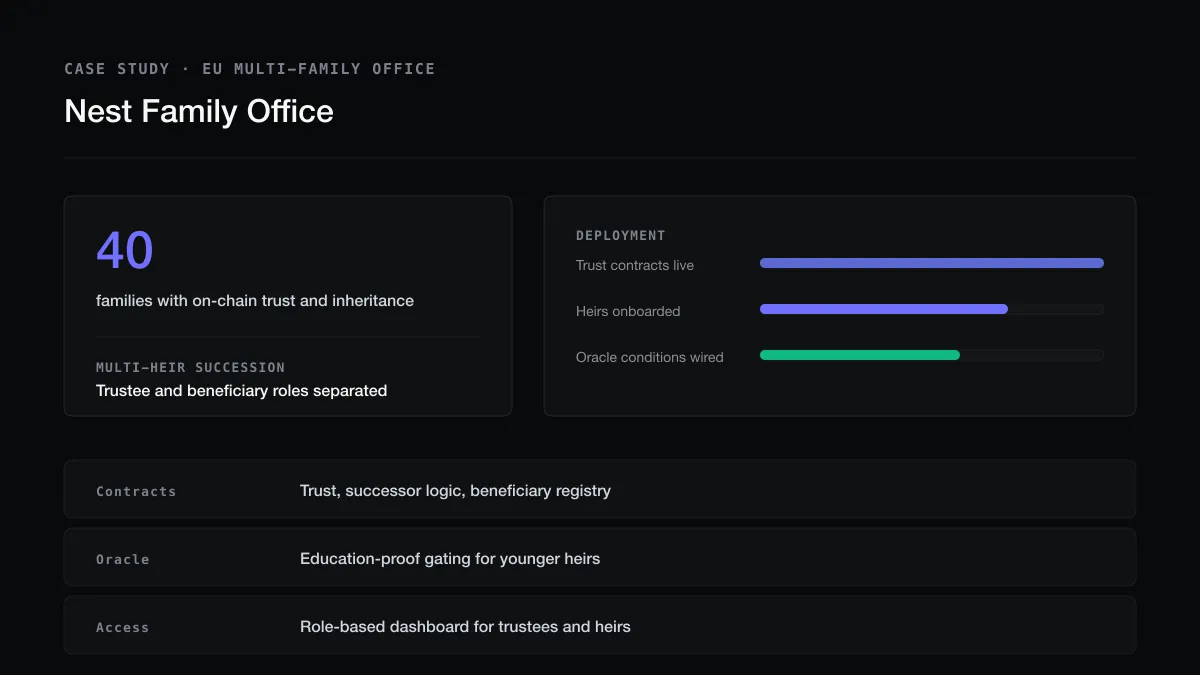
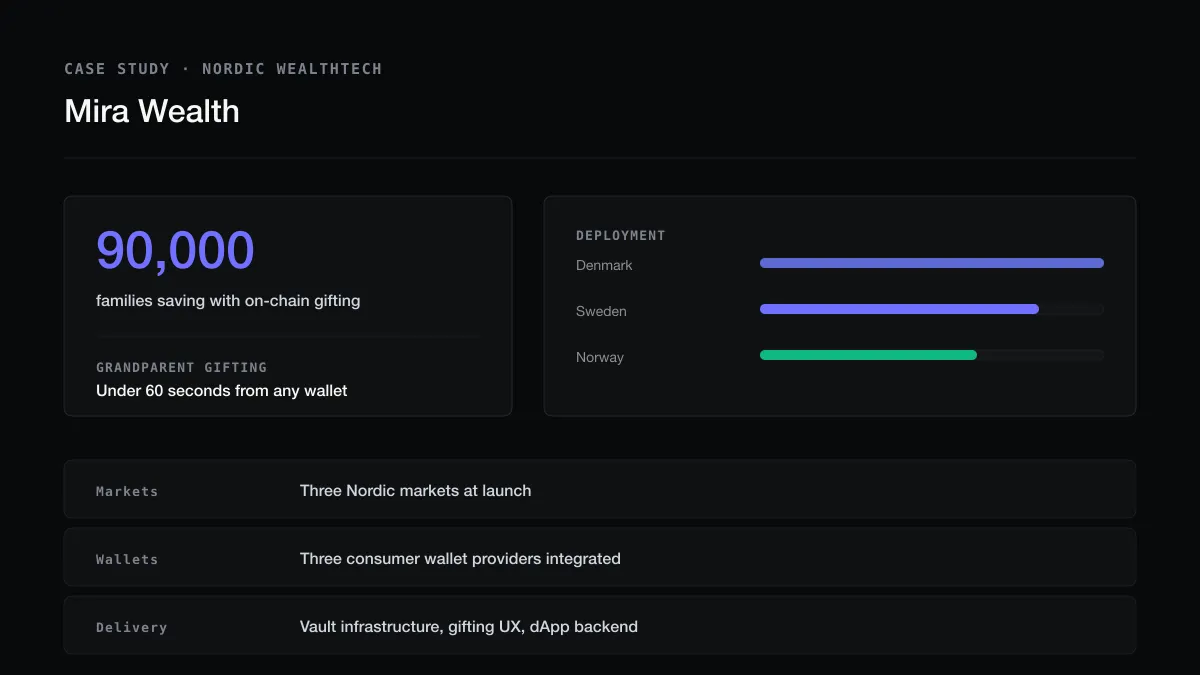
Three deployments running in production: a German savings bank, an EU multi-family office and a Nordic wealthtech platform. Each entry states the challenge the client arrived with, what Blockchain Baby actually built and the result measured after launch, rather than a client logo and an adjective.
Five phases carry a savings vault from the first call to mainnet, each with a stated duration, a named owner and an output the client signs off. Those minimums sum to six weeks, which is why a fixed-scope vault build is quoted at 6 to 10 weeks and never at four.
Two to three days with your team to map release conditions, beneficiary roles, regulatory requirements and chain selection. Produces a signed technical specification and engagement agreement.
Our engineers design the vault contract architecture, beneficiary registry and custody model. Smart contract threat modeling and key management design are written before any code. You review and approve the design before implementation begins.
Vault contracts, beneficiary management and integrations built in Solidity (or Rust for Solana). Smart contract testing covers unit, integration and fuzz tests with high contract test coverage targets. Staged deployment to testnet with your QA team before any production rollout.
Mandatory third-party audit by a reputable firm before any mainnet deployment. All findings remediated and confirmed. Audit report delivered to you and optionally published. No contract ships without a clean audit.
Staged mainnet rollout with monitoring. Full handover documentation, runbooks and source code. Your team is trained on upgrade paths and emergency procedures. Sustain retainer optionally activated.
Every engagement ends with a complete handover package: audited source code, the external audit report, a deployment runbook, the threat model and risk register, API and SDK documentation and knowledge transfer sessions. Nothing sits behind a proprietary system and nothing carries a licence fee afterwards.
All smart contracts, test suites and deployment scripts in a private GitHub repository transferred to client ownership on the day of mainnet handover.
Full findings report from the independent auditor, including remediation evidence for all findings, published or kept confidential per client preference.
Step-by-step documentation covering contract deployment, upgrade procedures, key rotation and emergency pause procedures.
A written threat model covering vault contract attack surfaces, oracle manipulation scenarios and custody key risks.
Developer documentation for all public contract interfaces, event schemas and integration patterns, including example code for common operations.
Two structured sessions (architecture walkthrough and operational runbook) with the client's technical and compliance teams after mainnet deployment.
Every engagement opens with a free scoping workshop and a fixed-price discovery phase, so the commercial shape is settled before anything is signed. Six commitments follow from that: client-owned IP from day one, an audit-pass commitment, no vendor lock-in and a defined exit with a structured handover.
A two-day scoping workshop at no charge. If we cannot deliver what you need within your budget, we say so before any agreement is signed.
A fixed-fee technical discovery sprint (typically 5 days) produces a detailed specification, architecture diagram and written timeline before the main engagement begins.
Smart contract source code, test suites and deployment keys transfer to client ownership at mainnet deployment, not on a 12-month retention schedule.
We do not deploy to mainnet until the external auditor clears all critical and high findings. If a re-audit is required to clear findings, we cover the cost. That discipline is why the record reads EUR 0 funds lost after 74 production contracts.
All contracts are deployed to standard chains using open-source tooling. Your team can maintain and upgrade them without Blockchain Baby involvement.
A two-week structured handover at project close. All documentation, credentials and code are transferred in a documented offboarding procedure.
Week 1: Scoping workshop, technical discovery sprint, architecture review.
Week 2: Smart contract design, threat model draft, regulatory framework mapping, client approval before build starts.
The payment schedule, the invoicing terms and what happens to the code if an engagement stops early. All of it sits in the engagement agreement signed at the end of the scoping workshop, and none of it changes after signature. Six cards below state each term in full.
A fixed-scope vault build is invoiced against four milestones, each released only when you have accepted the output named in the delivery path.
Invoices are issued in EUR from Luxembourg, payable by SEPA transfer within 14 days. Luxembourg VAT applies unless you supply a valid EU VAT number for the reverse charge. Time-and-materials work is invoiced monthly in arrears at EUR 1,400 per engineer day.
Either side may stop a fixed-scope engagement at a milestone boundary with 15 working days of notice. You keep every deliverable already invoiced, and the source and IP transfer to you on the last cleared invoice rather than at project close.
There is no exit fee, no licence fee on contracts we wrote for you and no charge for the two-week structured handover. Re-audits needed to clear findings our own code caused are ours to pay, which is the same commitment that keeps the record at EUR 0 funds lost.
Scope changes are quoted as a written addendum before any work starts on them, priced at the same day rate as the original engagement. We do not absorb scope silently and then rediscover it as a delay in week seven.
Engagement agreements are governed by Luxembourg law with exclusive jurisdiction in the courts of Luxembourg City. Liability is capped at the fees paid under the engagement, except where Luxembourg law does not permit a cap.
Blockchain Baby was founded in 2006 by Jonas Albrecht, after a career spent between savings technology and software engineering that included leading engineering at a digital wealth platform and building the custody and beneficiary system at a private bank. Sixty-seven engineers work on the vaults today.
Jonas Albrecht has spent his career at the intersection of savings technology and software engineering. After leading engineering at a digital wealth and robo-advisor platform and building the custody and beneficiary system at a private bank, he saw the same problem at every institution: long-term savings products were opaque, inflexible and quietly expensive.
"When my first child was born in 2017, opening a long-term savings and trust account meant paperwork, opaque fees and no control over the conditions. I built the first version of what became Blockchain Baby that same year: a programmable savings vault where I could see exactly what the rules were and so could my child when the time came."
Blockchain Baby S.a r.l. was built on that principle. Today a team of 67 engineers in Luxembourg and Vienna builds savings, trust and inheritance infrastructure for banks, wealth platforms and family offices across Europe and beyond. Clients come to us as their long-term blockchain technology partner: the blockchain strategy, architecture, engineering and sustain all come from a single team that knows their domain. Every vault ships with transparent fees, parent-set release rules and an external security audit. Every child deserves a head start you can see.
A dedicated team is assembled from a 67-engineer pool for each engagement. Seven roles appear on every vault or trust platform project: vault architect, smart contract engineer, security and audit lead, compliance specialist, integration engineer, QA and test engineer and engagement manager, each with a defined responsibility.
Designs the overall smart contract architecture including vault factory, beneficiary registry and custody model before a line of code is written.
Writes and reviews all Solidity or Rust contract code, targeting 100% branch test coverage on every production vault.
Manages the external audit process, owns the threat model, reviews all contract code for vulnerabilities and signs off all findings remediations.
Maps regulatory requirements (CSSF, MiCA, AML/KYC, GDPR) to on-chain architecture decisions and documentation deliverables.
Connects vault contracts to oracle providers, node infrastructure, custodian APIs and the client's existing core banking or wealth platform.
Runs fuzz testing, integration testing and testnet UAT. Manages the test coverage report shared with the client and auditor.
Owns the delivery timeline, client communication and handover documentation. The single point of contact throughout the project.
Research Note BBBY-2026-06 analyses 1,400 family savings and trust structures held across Blockchain Baby platform partnerships. It finds that 68 percent of long-term child savings were eroded by opaque fees and inflexible conditions rather than by market performance, and that fee load fell 80 percent after migration.
Analyses 1,400 family savings and trust structures accumulated across our platform partnerships. Finds that 68 percent of long-term child savings were eroded by opaque fees and inflexible conditions rather than by market performance. Presents the Blockchain Baby programmable savings and trust protocol with parent-set release rules and a published fee schedule. The protocol relies on secure DeFi smart contracts with formal release logic in place of opaque bank-internal conditions. Findings: fees fell 80 percent and all releases became transparent and rule-based.
Artificial intelligence is changing how savings vaults are governed, how custody risk is scored and how beneficiary conditions get verified. Blockchain Baby tracks three integration patterns already reaching production: release condition verification, on-chain risk scoring for custody decisions and autonomous agents that save on a household's behalf.
Language model pipelines now process university admissions documents and age certificates as vault oracle inputs, reducing the manual verification step for education-gate conditions from days to seconds.
Machine learning models deployed as off-chain data feeds provide real-time risk scores for multi-sig custody decisions, flagging anomalous withdrawal patterns before a transaction reaches the vault contract.
Early-stage integrations allow AI agents to rebalance savings allocations between vault positions automatically based on beneficiary milestones, market conditions and preset family preferences, all settled on-chain with full audit trails.
Every savings vault platform integrates with production-grade protocols rather than reimplementing them badly. Nine appear across Blockchain Baby deployments, covering node infrastructure, oracles, indexers, multi-signature custody and institutional key management, and each link below points at the provider's own live site rather than at a summary.
Audited base contracts for ERC-20, ERC-4626 and access control
As more users rely on and contribute to a data feed, the quality of the data feed improves.
It is also the argument for using a shared feed rather than a private one for an education-proof gate. A release condition checked against infrastructure nobody else audits is a condition only we can vouch for.
Fifty-one verified reviews across two platforms: 4.9 on Clutch from 30 reviews and 4.8 on G2 from 21. Five appear below in full, each carrying the reviewer, the platform and the month it was written, reproduced as text rather than served through a third-party review widget.
Both scores were last read at their own profile pages on and are reproduced here as text. We run no third-party review widget on this page, so nothing on it can silently restate a score we have not checked. 51 reviews across the two platforms.
"We went from 12 weeks to onboard a child savings product to 6 weeks for our first vault deployment. The parent-set release rules were exactly what our compliance team needed: conditions are on-chain and nobody at the bank can quietly change them after the fact."
"Our families wanted trust and inheritance structures they could actually see and verify. Blockchain Baby delivered contracts with transparent beneficiary logic that our trustees can explain to clients in plain language. EUR 0 in fees that were not disclosed upfront."
"The gifting module was the differentiator for us. Grandparents and relatives can contribute to a child's vault in under 60 seconds from any wallet. Retention metrics on gifting families are 40 percent higher than on standard savings users."
"We benchmarked four blockchain development companies for our family savings product. Blockchain Baby was the only team that had done this specific type of work before. Setup time of 4 minutes per vault was validated in our UAT before we signed the contract."
"Our private clients wanted estate planning that their heirs could verify without a lawyer. Blockchain Baby built on-chain inheritance contracts where beneficiaries can see their entitlement on-chain today. The transparency is the product."
Nine credentials, each named with the body that issued it and the certificate or report number where one exists. Two are audited certifications, two are compliance postures, one is a completed data protection impact assessment and four are third-party awards and rankings from Clutch, G2 and two European programmes.
Blockchain Baby engineers publish and speak on programmable savings, custody design and on-chain succession. Five appearances are listed below across industry press, conference programmes and technical publications, each named rather than described in the abstract, so a reader can go and check what was actually said there.
Fourteen questions covering what a programmable savings vault is, how parent-set release rules are enforced on-chain, what a build costs and how long it takes, which chains suit which product, plus what a buyer should ask any blockchain development company before signing anything at all.
A blockchain development company designs, builds and deploys the smart contracts, protocols and platform infrastructure that run an application on a blockchain network. The work spans contract engineering, security review, chain selection and the interfaces that non-technical users actually touch.
Blockchain Baby builds one thing: programmable savings vaults, trust fund structures and beneficiary management systems for banks, wealth platforms and family offices. Every engagement ends with contracts a family can read and an audit report the institution can file.
The question worth asking a supplier is whether they have built the specific thing you need, not blockchain in general. We have shipped 74 production contracts in savings and succession and nothing outside it.
A single programmable savings vault build starts at EUR 45,000 as a fixed price. That covers the contract, the parent-set release rules, gifting support and an external security audit on one chain.
A full savings, trust and beneficiary platform runs from EUR 95,000 to EUR 280,000. A white-label family savings app starts at EUR 320,000, including the consumer frontend and the first year of sustain.
Time-and-materials work is billed at EUR 1,400 per engineer day and sustain retainers start at EUR 12,000 per month. The benchmark table on this page sets each of those against a published market range where one exists.
A focused savings vault build takes 6 to 10 weeks from the scoping workshop to mainnet. Six is a floor rather than a target: five phases each have a minimum and the external audit alone accounts for two weeks of it.
A full savings and trust platform takes 14 to 22 weeks including the external audit. A white-label app with gifting and beneficiary management typically takes 20 to 30 weeks.
Compressing below six weeks is possible on a time-and-materials basis with a larger parallel team. It never comes out of the audit, which is the one phase we will not shorten to hit a date.
A programmable savings vault is an on-chain smart contract that holds funds for a beneficiary, usually a child or young adult, under conditions set by the depositor, usually a parent or a family office.
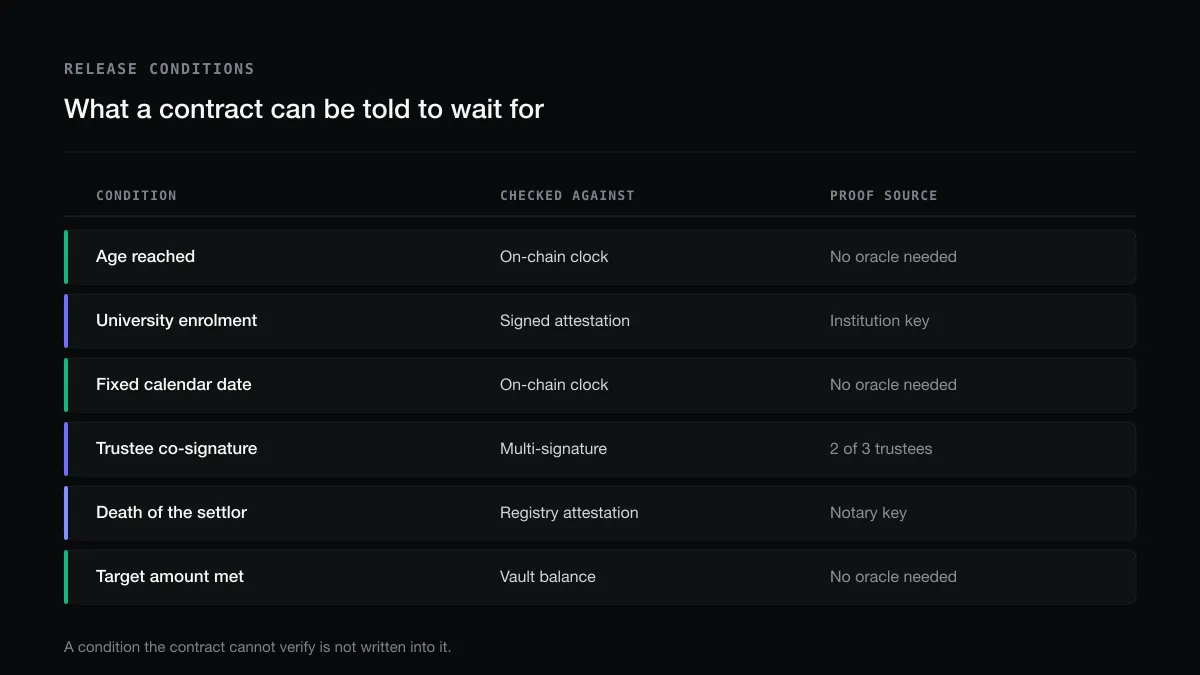
The release conditions, the fees and the vesting schedule live in auditable code rather than in a bank's internal system. A parent can set release at a given age, on university enrolment, on a fixed date or on a combination of them.
The practical difference is who can change the rule afterwards. A policy inside a bank can be revised; a condition inside a deployed contract is the contract, and nobody at the institution can quietly move it.
When a vault is created, the depositing parent or institution sets the release conditions as parameters in the contract: a minimum age expressed as a block timestamp, an optional proof-of-education gate through an oracle, a vesting tranche schedule or any combination of the three.
The contract then enforces those rules on its own. No bank and no intermediary can override or quietly modify them, and every change that is permitted at all leaves an on-chain record of who made it.
We only write a condition the contract can verify. Six release conditions have gone to production and three of them need no oracle at all, which makes them both the cheapest to audit and the hardest to dispute later.
We build on Ethereum, Base, Polygon PoS, Arbitrum One, Optimism, Gnosis Chain and Solana. Which one fits depends on the client's regulatory jurisdiction, fee sensitivity and existing infrastructure.
For regulated banks and wealth platforms in Europe, Ethereum mainnet and Gnosis Chain are the usual choices, for their stability and for the compliance tooling already built around them.
For high-volume consumer apps, Base and Arbitrum One keep the per-deposit cost low enough that a five euro birthday gift is still worth making. The chain selection table on this page sets the trade-off out row by row.
Once the platform is live, an end user creates a new savings vault in about 4 minutes through the platform's own interface.
The vault is deployed as a contract instance carrying the parent's chosen release rules and is live on-chain immediately. There is no manual approval step in between and no overnight batch.
Gifting from a grandparent or another relative into an existing vault takes under 60 seconds, from whatever wallet the contributor already uses.
Blockchain Baby holds ISO/IEC 27001:2022 certification under certificate BBBY-IS-2026-0628, issued by DEKRA and valid through for the current cycle. A SOC 2 Type II audit is complete under report BBBY-SOC-2026-H1, audited by Aprio.
We operate CSSF-aligned in Luxembourg, are PCI DSS compliant and have completed a full GDPR DPIA covering every vault and beneficiary data processing activity.
All contracts are externally audited before mainnet deployment. We have shipped 74 production contracts with zero critical findings and EUR 0 funds lost.
The beneficiary management module keeps a registry of vault-to-beneficiary mappings with role-based access for the depositor, a co-depositor, a guardian and the beneficiary. Each role is a permission written into the contract rather than a setting in a back office tool.
A family office managing 40 families administers hundreds of vaults from a single dashboard, with per-vault overrides and a full audit trail behind every action a trustee takes.
Inheritance is handled by a designated successor contract that routes vault ownership on a verified triggering event. An heir can read the entitlement on-chain instead of writing to a trustee to ask what it is.
Yes. Every savings vault exposes a public deposit interface that any wallet can call to contribute funds.
The release conditions the parent set apply to every deposit regardless of who made it. A grandparent's birthday gift enters the vault under exactly the same age lock or education gate as the parent's regular contributions.
The gifting module adds a dedicated flow and an optional gift message stored off-chain. On one Nordic deployment the client reported retention among gifting families running 40 percent higher than among standard savings users.
In a savings context, tokenization means representing a vault position or a claim on future funds as an on-chain token that can be tracked, transferred or pledged as collateral.
We implement it for institutional savings products where the underlying deposit is tracked as a standardised token. That is what makes family office co-investment structures and regulatory reporting workable at all.
Tokenization does not change the release rule. A tokenized position still unlocks on the condition the vault contract carries, and the token records the claim rather than offering a way around it.
Start with direct experience. Ask how many savings vault and custody contracts the company has put into production, and ask to read the audit reports rather than the case study written about them.
Then check the process and the certifications: a scoping workshop before commitment, independently audited contracts with zero critical findings, and ISO 27001, SOC 2 and PCI DSS where payment-adjacent operations are in scope.
Settle ownership and regulatory coverage before signature, not at handover. Confirm in writing that IP and source transfer to you, and confirm which of MiCA, AML and KYC and FATF the supplier has actually worked under.
At minimum, look for ISO/IEC 27001 for information security management and SOC 2 Type II for security, availability and confidentiality. PCI DSS compliance belongs on the list wherever payment-adjacent operations are in scope.
For European deployments, CSSF-aligned operations and a completed GDPR DPIA are expected as well. A supplier who cannot name the assessing body and the certificate number for each is not ready for a regulated buyer.
Blockchain Baby holds ISO/IEC 27001:2022 (Certificate BBBY-IS-2026-0628, DEKRA) and SOC 2 Type II (Report BBBY-SOC-2026-H1, Aprio), operates CSSF-aligned in Luxembourg and has completed its DPIA.
Ask for the external audit reports for every contract in production. Not a summary, not a badge on a website, the reports, from named firms, with the scope stated.
Then ask what happened to the findings. The number that decides anything is not how many were raised but how many were still open on the day the contract went to mainnet.
Every Blockchain Baby contract is independently audited before mainnet, all critical and high findings are remediated and confirmed, and we pay for the re-audit whenever the finding is ours.
Ten terms that recur across programmable savings and trust engagements, defined the way Blockchain Baby uses them rather than in the abstract. Each entry is short enough to quote on its own and specific enough to check against the contracts and the delivery path described elsewhere on this page.
Ready to build programmable savings infrastructure? Reach out to discuss your requirements. We typically respond within one business day.
hello@blockchain-development-company.baby
+352 27 86 4200 · Mon-Fri 09:00-17:30 CET
9 Rue du Laboratoire, L-1911 Luxembourg City, Luxembourg
Satellite office: Vienna, Austria (wealth partnerships)
Blockchain Baby S.a r.l., 9 Rue du Laboratoire, L-1911 Luxembourg City, Luxembourg. VAT: LU 28934176. Contact: privacy@blockchain-development-company.baby.
This landing page collects no personal data by default. If you contact us by email, we store your email address and the content of your message to respond to your enquiry.
Legitimate interests (Article 6(1)(f) GDPR) for responding to business enquiries. Enquiry data is deleted after 24 months or when no longer required.
You have the right to access, rectify, erase and port your data and to object to processing. Contact privacy@blockchain-development-company.baby. Complaints: Commission Nationale pour la Protection des Donnees (CNPD), Luxembourg.
This website is published by Blockchain Baby S.a r.l. for informational purposes. The content does not constitute financial, legal or investment advice. No offer or solicitation to buy or sell financial instruments is made on this site.
All content, design and code on this site is the property of Blockchain Baby S.a r.l. or its licensors. Reproduction for non-commercial purposes with attribution is permitted. Commercial reproduction requires written consent.
These terms are governed by the laws of Luxembourg. Disputes are subject to the exclusive jurisdiction of the courts of Luxembourg City.
All metrics on this page reflect verified production data as of Q2 2026. Case study figures are drawn from client-approved impact reports. Research findings are from Research Note BBBY-2026-06 ().
This page is reviewed and updated at least annually. Editorial enquiries: editorial@blockchain-development-company.baby.
We follow a serial-comma-free style throughout. "FinTech" is always written with a capital F and capital T per industry convention.
9 Rue du Laboratoire
L-1911 Luxembourg City
Luxembourg
Vienna, Austria
Wealth partnerships
hello@blockchain-development-company.baby
security@blockchain-development-company.baby
research@blockchain-development-company.baby
Blockchain Baby S.a r.l.
RCS Luxembourg: B 218447
VAT: LU 28934176